 Online Dice
Roll 3d6 online – 3 6-sided dice
3d6 · 3 separate 6-sided dice
A comfortable center for three cubes 📈
Three D6s give a familiar 3–18 range with most of the probability near the middle. It is a useful way to see how adding independent dice smooths a distribution, and a convenient tray for any rule that specifies 3d6.
🍜 The familiar total arrives before the arithmetic
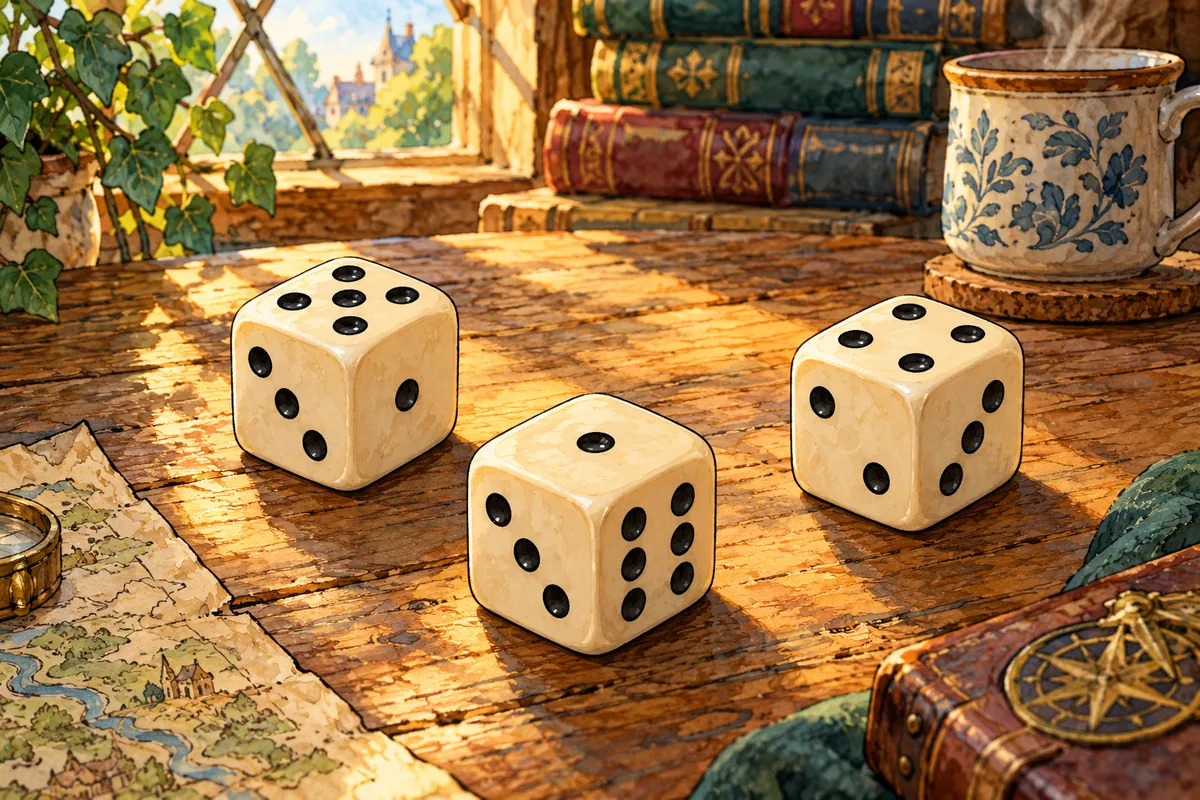
Three D6s are classic enough that the total already feels familiar before you calculate it.
A roll beside the two central favorites
The example adds 6, 2, and 3 to make 11. Totals 10 and 11 are tied for the most ordered outcomes. You can reach either with different arrangements, which is why looking at one lucky-looking triple tells only a small part of the story.
Raw sum6 + 2 + 3 = 11
Ten and eleven share the three-cube peak
| Total | Ordered sets | Chance, rounded |
|---|---|---|
| 3 | 1 | 0.46% |
| 10 / 11 | 27 each | 12.5% each |
| 18 | 1 | 0.46% |
Standard independent-dice model: 216 ordered outcomes. Percentages are rounded.
A bell-like shape still has discrete steps
This is an exact dice distribution with integer totals, rather than a continuous normal curve. The endpoints remain possible. Use the probabilities to understand the shape, not to demand that a short session match it perfectly.