 Online Dice
Roll 2d20 online – 2 20-sided dice

2d20 · 2 separate 20-sided dice
Two D20s can tell three different answers ⚔️
A pair of D20s can supply a sum, two separate checks, or a keep-highest or keep-lowest result. The procedure matters as much as the faces. Decide which answer you need before the two dice settle.
🍜 Advantage arrives before anyone invites it
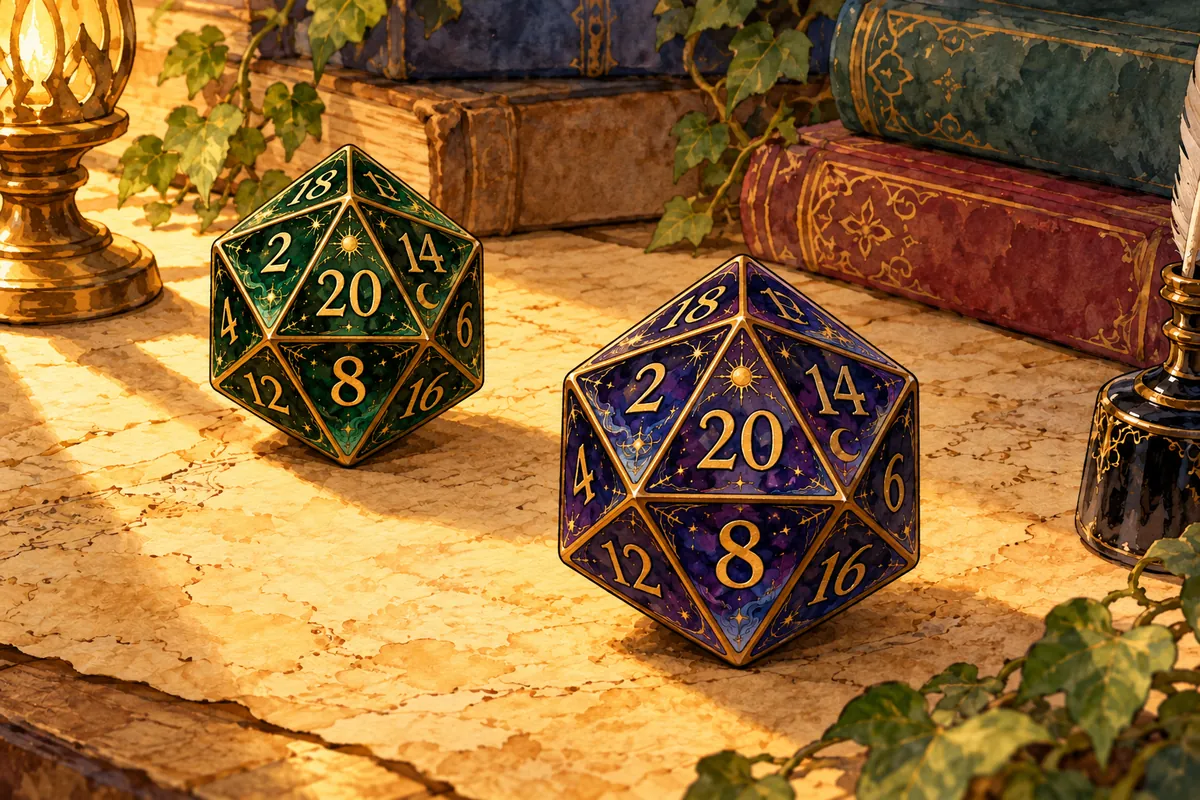
Two D20s invite the words "advantage" and "disadvantage" even when nobody asked.
Seven and sixteen at the table
The example faces sum to 23. Keeping the higher gives 16, while keeping the lower gives 7. For a threshold of at least 15 with no modifiers or special rules, one D20 succeeds 30% of the time; keeping the higher of two gives 51%, and keeping the lower gives 9%.
Raw sum7 + 16 = 23
Advantage is a reading rule for the pair
A game-specific advantage procedure uses the appropriate individual result rather than the sum. The D&D presets provide a matching starting point. A rule that actually requests 2d20 can instead use the arithmetic total shown here.
The arithmetic sum has its own twenty-one-point center
| Total | Ordered sets | Chance, rounded |
|---|---|---|
| 2 | 1 | 0.25% |
| 21 | 20 | 5% |
| 40 | 1 | 0.25% |
Standard independent-dice model: 400 ordered outcomes. Percentages are rounded.