Online Dice
🌀

Roll 1d4 online – a 4-sided die


MODIFIERS
Add bonuses, penalties or multipliers. They apply from top to bottom.


1d4 · one choice from 4 outcomes

Small die. Sharp decisions. 🔺

The D4 keeps the range small: 1,2,3, or 4. Roll it for a little damage, a compass direction, or a four-entry table. The virtual version also has a welcome advantage for bare feet.
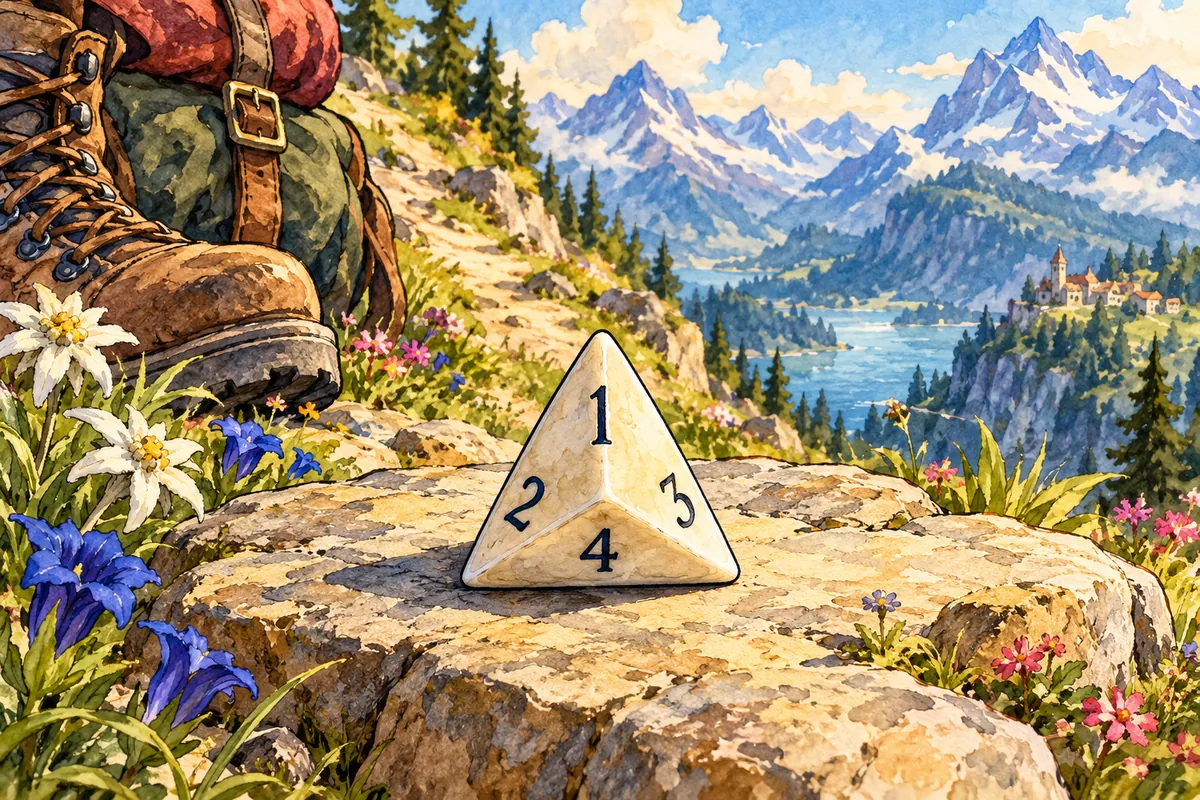
A 4-sided die (D4) on a tabletop map - small roll, big consequences.
Four faces. One tiny verdict. Somehow it still hits like a plot twist. 🎭

🎲 D4 Roller - Roll a 4-sided Die Online (1D4)

The D4 is small, sharp, and oddly philosophical: four outcomes, zero drama... until it lands. Use this 1D4 roller for quick RPG checks, "tiny randomness," and decisions that shouldn't require a spreadsheet. 🍜

🧩 What Is a D4 (1D4)?

A D4 is a four-sided die. In many tabletop sets it's the little pyramid (the one that is famously not barefoot-friendly). Digitally, it's the cleanest form of "small range randomness": 1, 2, 3, or 4 - no extra noise.

In RPG terms, 1D4 is often used for minor damage, small bonuses, potion effects, short durations, and "tiny tables" that still feel gamey without becoming chaotic.

🎯 Why Roll D4 Instead of Something Bigger?

Low variance, high clarity

D4 keeps outcomes tight. Great when you want a nudge, not a meteor. It's the dice equivalent of "just a little spice." 🌶️

Fast tables, quick rulings

A D4 table is easy to remember and improvise. If your GM brain is tired, D4 is a friendly assistant that doesn't argue. 🙂

"Small roll" storytelling

Four outcomes are enough to create tone: bad / ok / good / excellent. Minimalism that still feels alive. ✨

Perfect for serious systems too

Even crunchy games use D4 for controlled modifiers (bleed ticks, minor crit riders, limited ammo variance). It's "math-safe" randomness. 📈

🛡️ D4 in RPG Systems (Real Use Cases)

In many fantasy systems, D4 shows up as: dagger damage, small spell riders, healing herbs, short buffs, and "light consequences." It's also common in OSR-style games where small numbers matter a lot.

In more serious / simulation-ish play, D4 is a clean way to add uncertainty without breaking balance. For example: fatigue change, morale drift, weather shift, or "how loud was that mistake?". A D4 doesn't wreck probability - it seasonings it. 🍜

🧰 Common 1D4 Uses

  • 🗡️ Minor damage (dagger, improvised weapons, small creatures)
  • 🧪 Potion side effects / light healing variance
  • ⏱️ Short durations (rounds, minutes, "until the vibe changes")
  • 🧠 Quick prompts: mood, rumor quality, NPC reaction tier
  • 🌦️ Micro-weather tables: drizzle / wind / calm / "ok... thunder"

🧷 Interpretations (Tiny Range, Big Meaning)

Sometimes you don't need "infinite possibility" - you need four clean lanes. Here are practical reads you can reuse:

🎭 Tone scale

1 grim · 2 tense · 3 hopeful · 4 legendary

🧭 Direction / choice

1 north · 2 east · 3 south · 4 west

🍜 "Noodle logic"

1 dry · 2 edible · 3 tasty · 4 suspiciously perfect

📌 Outcome bands

1 fail · 2 partial · 3 success · 4 success + bonus

❓ FAQ (D4 Roller)

Is rolling 1D4 online "fair"?

For casual play, the roller models equal chances for the four outcomes; that describes the model, rather than an independently certified fairness result. If you want extra ritual, tap the button like you're blessing instant noodles. Statistically useless, emotionally essential. 🍜

Why do people fear stepping on a D4?

Because geometry. Physical D4s are tiny pyramids with pointy intentions. Digitally, they're harmless. 😄

When should I use D4 instead of D6?

Use D4 when you want tighter outcomes, or your table entries naturally fit into 4 categories. Use D6 when you want more gradation and "middle results."

🔗 Choose another shape for the small-table ritual

Need a different range? Try: D3 - minimal randomness · D6 - classic · D8 - broader damage · ♾️ Any-Dice Generator

Tip: if you're writing tables, D4 is perfect for "quick flavor" without derailing serious balance. 📌

for players / practical use

Keep the damage small and the table short

  • Small damage and healing rolls in tabletop RPGs.
  • Four-entry random tables and directions.
  • Compact dice pools when low totals are useful.
  • Randomly picking one of four players or choices.
⚡ Common rolls
With 2d4, middle totals appear more often than the extremes. A total of 5 is much more common than 2 or 8.

Which way should the party go?

For a simple direction table, write 1 = north, 2 = east, 3 = south, and 4 = west. Roll once and read the matching direction. Each direction has a 25% chance; rolling several D4s would select several directions, not make one selection more precise.

Illustrated face: 3 → south.

D4 worked selection: 3NESWFace 3 → S
One example selection · D4

Four jobs for four faces

Four compass directions, four seasons, four available actions, or a short encounter table all fit neatly. In a game, use the die size written in the rule rather than substituting a larger one because it looks more exciting.

Reading a physical tetrahedron

A virtual D4 displays the result directly. On a physical tetrahedral D4, the readable number may be at the top or along the bottom, depending on the design. That physical reading convention does not add another outcome here.

D4 plus D4 changes the distribution

A D4 result has an average of 2.5 over many rolls. Two D4s have an average total of 5, whereas a single D8 averages 4.5. Matching the maximum does not make the rolls interchangeable.

Every direction gets one quarter

25%per named result in the uniform-die model

The mean is 2.5 over many rolls. No individual D4 shows 2.5; the average is a summary of the four-value range. North and south keep equal weights when each has one row.

🎲 Roll⌨️ Enter👆 Tap the dice🔊 Optional sound