 Online Dice
Roll 1d3 online – a 3-sided die
1d3 · one choice from 3 outcomes
Three paths, one small nudge 🛤️
A D3 chooses between three numbered options. It is handy for a short prompt list or a small damage expression, and spares you the task of interpreting a larger die. Three possibilities are plenty when the choices are already interesting.

🎲 D3 Roller - Roll a 3-Sided Die Online
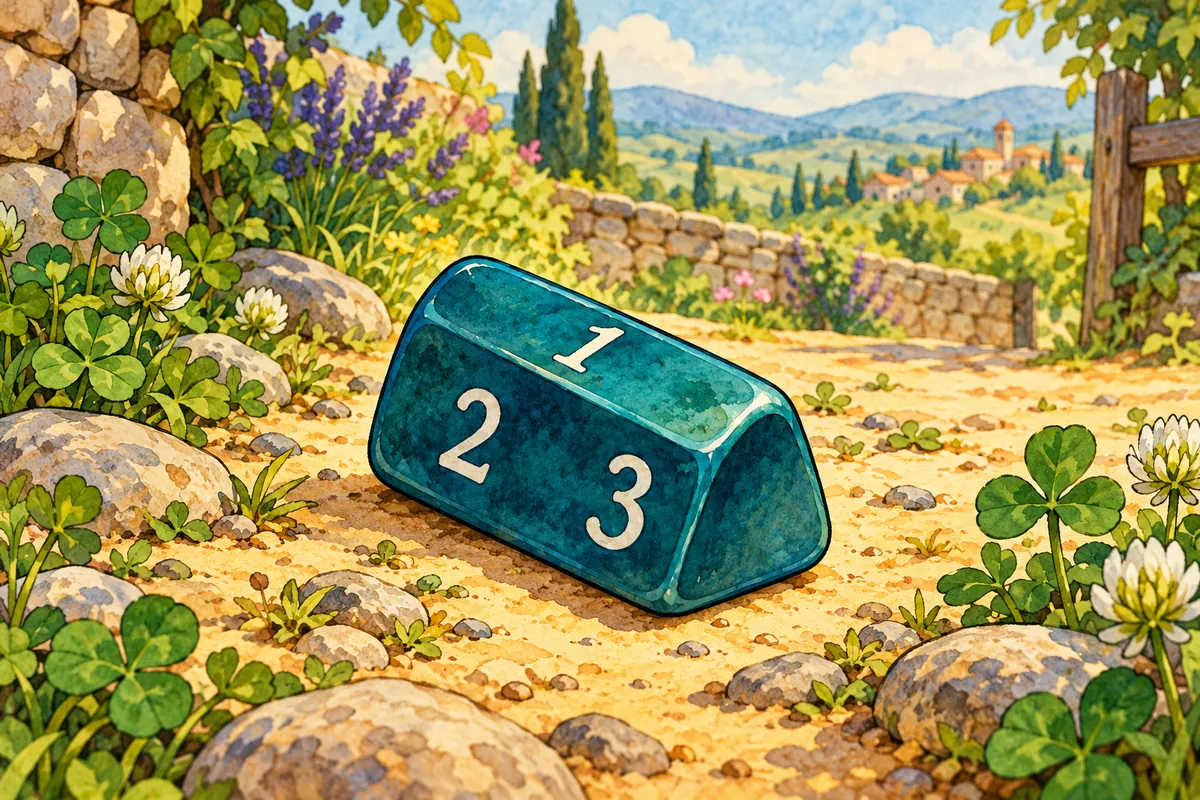
When two options feel too strict and six feels like paperwork - roll a D3. Three outcomes, clean odds, and just enough uncertainty to keep a story honest. 🙂
The D3 (3-sided die) is a compact probability tool used in tabletop RPGs for controlled randomness: small damage ranges, tiered results, and "soft decisions" where you want nuance without chaos. It's the die equivalent of a measured sigh: not dramatic, but meaningful. 🍜
🧩 What is a D3 (3-sided die)?
A D3 is any method that produces a number from 1 to 3 with equal probability. Physical D3 dice exist, but at most tables the D3 is simulated - usually because a D6 is already present and the group would rather play than shop.
Conceptually, D3 sits in a sweet spot: more expressive than a binary flip, but still small enough that outcomes remain easy to interpret, narrate, and balance.
⚙️ How to roll a D3
💻 Online D3 roller
Click Roll to get a fair result from 1-3 instantly. No conversions, no table drift, no dice falling into the shadow realm under the couch. 🛋️
🎲 Convert a D6 (classic table method)
Roll a D6 and map results: 1-2 → 1, 3-4 → 2, 5-6 → 3. Same odds, simple logic, minimal drama.
🧙 D3 in RPGs (practical uses)
Designers and GMs use D3 when they want variation without volatility. It's common for "minor but relevant" effects - the kind that shape play over time without turning a scene into a lottery.
🩹 Minor damage & chip effects
Great for small, frequent hits: hazards, bleeding ticks, weak spells, fatigue, environmental consequences, and "you did that badly enough to matter."
📊 Three-tier intensities
A neat scale for outcomes: low / medium / high. Use it for spell strength, reaction severity, complication intensity, or morale shifts.
🗂️ Compact tables
When a table only needs three entries (weather mood, clue quality, NPC reaction), D3 keeps pacing tight and results easy to remember.
⚖️ Fast GM rulings
A popular narrative mapping: 1 = No, 2 = Yes, but..., 3 = Yes. Instant pacing, minimal arguing. 😉
The middle result (2) is where stories like to live. Not a rule - just an observation. 🙂
📐 For serious systems
In more rules-focused or simulation-leaning games, D3 is used to keep ranges tight and predictable. Common clean interpretations include:
- Quality tiers: 1 = poor · 2 = standard · 3 = excellent
- Magnitude: 1 = minor · 2 = moderate · 3 = major
- Time/effort: 1 = quick · 2 = normal · 3 = slow
- Resource drain: 1 = light · 2 = medium · 3 = heavy
📈 Probability
A D3 has three equally likely outcomes: each is 1/3 (≈ 33.33%). This simplicity is why it's easy to balance and pleasant to use in play.
❓ The small questions behind three outcomes
Is a D3 a real physical die?
Yes - but uncommon. Most tables simulate it. As long as probabilities are equal, the shape does not matter. 📐
Why not just use a D6?
You can. A D3 just makes the intent clearer: three outcomes, no more, no less.
What does the middle result usually mean?
Often "partial success" or "mixed result". In serious systems: "standard". In narrative play: "this will have consequences."
🔗 Related dice
Explore nearby chaos levels: D2 · D4 · D6 · Any dice
Three outcomes for a hesitant scene
- Three-entry encounter, loot or direction tables.
- Picking one of three players, routes or options.
- Small random quantities in tabletop games.
- Situations where a D6 would give more granularity than you need.
A missing object starts the story
Number three story openings: 1 for an unexpected visitor, 2 for a missing object, and 3 for a strange message. A roll of 2 selects the missing object. Each entry occupies one result, so each has a one-in-three chance.
Illustrated face: 2 → the missing object.
Give every path one entry
Try it for three possible paths, three moods for a character, or a short list of writing prompts. You can also use D3 rolls to demonstrate a probability that is one third rather than one half.
One path out of three
The average face is 2, but the middle path has the same one-third weight as the other two. A small set of rolls can easily repeat one option before the others appear.
Borrowing a physical D6
A physical D6 can stand in for a D3 if you agree on a mapping such as 1–2 → 1, 3–4 → 2, and 5–6 → 3. Reading the raw D6 result as a D3 result without that mapping changes the range.
Two D3s have a favorite middle
Two D3s add to 2–6, but they do not behave like one D6. The middle total, 4, can occur in three different ordered ways; 2 and 6 have only one way each.