 Online Dice
Roll 1d9 online – a 9-sided die

1d9 · one choice from 9 outcomes
A little world in a 3 × 3 grid 🧩
Nine outcomes make a D9 a useful address picker for a small board. It can also choose one of nine names, prompts, or activities. Number the entries clearly and the unusual die size becomes an ordinary practical tool.
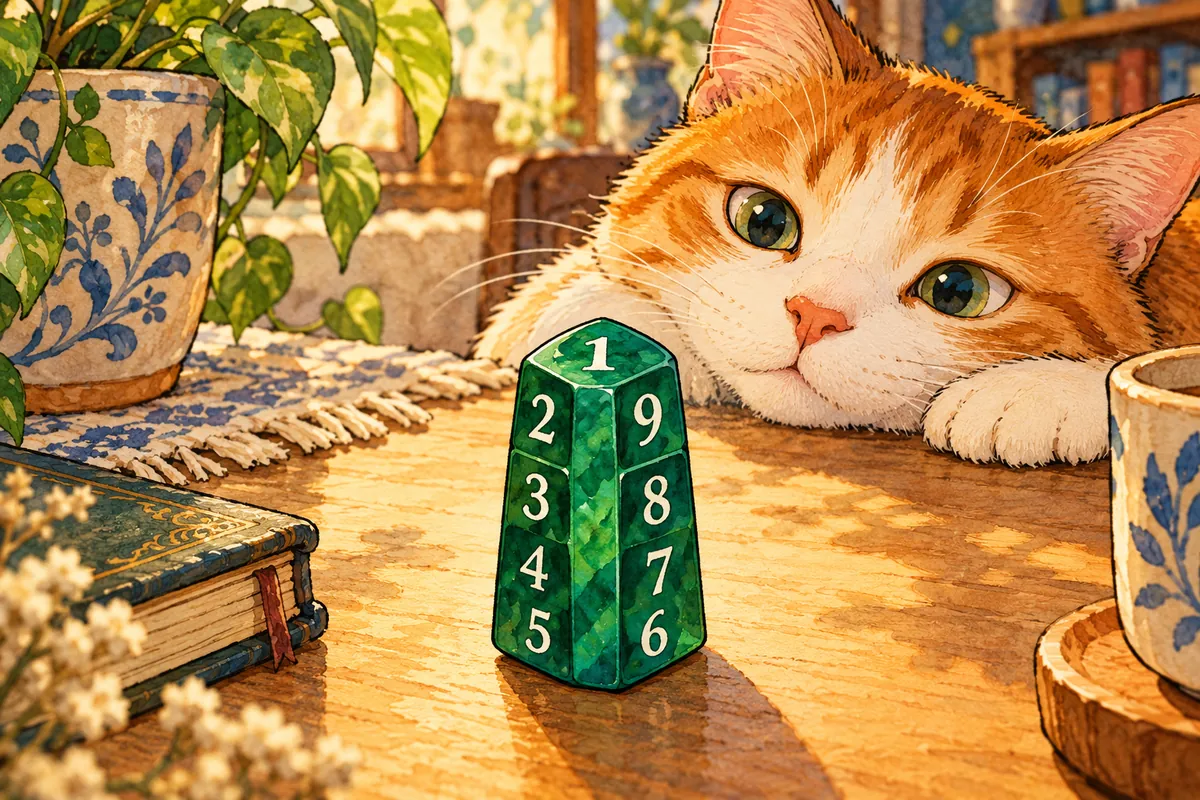
The center square is number five
Number a 3 × 3 grid from left to right, top to bottom: 1–3 in the first row, 4–6 in the second, and 7–9 in the third. A 5 selects the center. Each square has a one-in-nine chance, approximately 11.11%.
Numbered squares and coordinates are two useful choices
Use one D9 for a numbered grid square. If you prefer coordinates, read two D3s separately as row and column. The individual pair matters; its sum loses the coordinate information.
Give the grid a shared reading order
Number nine positions, nine character traits, or nine available activities. Agree on the numbering before the roll so the result is easy for everyone to interpret.
Nine squares share the board evenly
The average face is 5, which is also the center square in the illustrated numbering. The center is still no more likely than any corner: each square has one of nine outcomes.
Two coordinates need two separate D3s
Adding two D3s does not choose nine positions uniformly. The sum ranges only from 2 to 6. Two separately labeled D3 rolls can instead select a row and a column, giving nine equally likely pairs.