 Online Dice
Roll 1d10 online – a 10-sided die

1d10 · one choice from 10 outcomes
Ten answers, without decimal confusion 🔟
A D10 gives an ordinary number from 1 to 10. Use it for a ten-row table, damage, or a game that reads individual ten-sided dice. A percentile check has its own procedure, so decide which job you are asking this die to do.
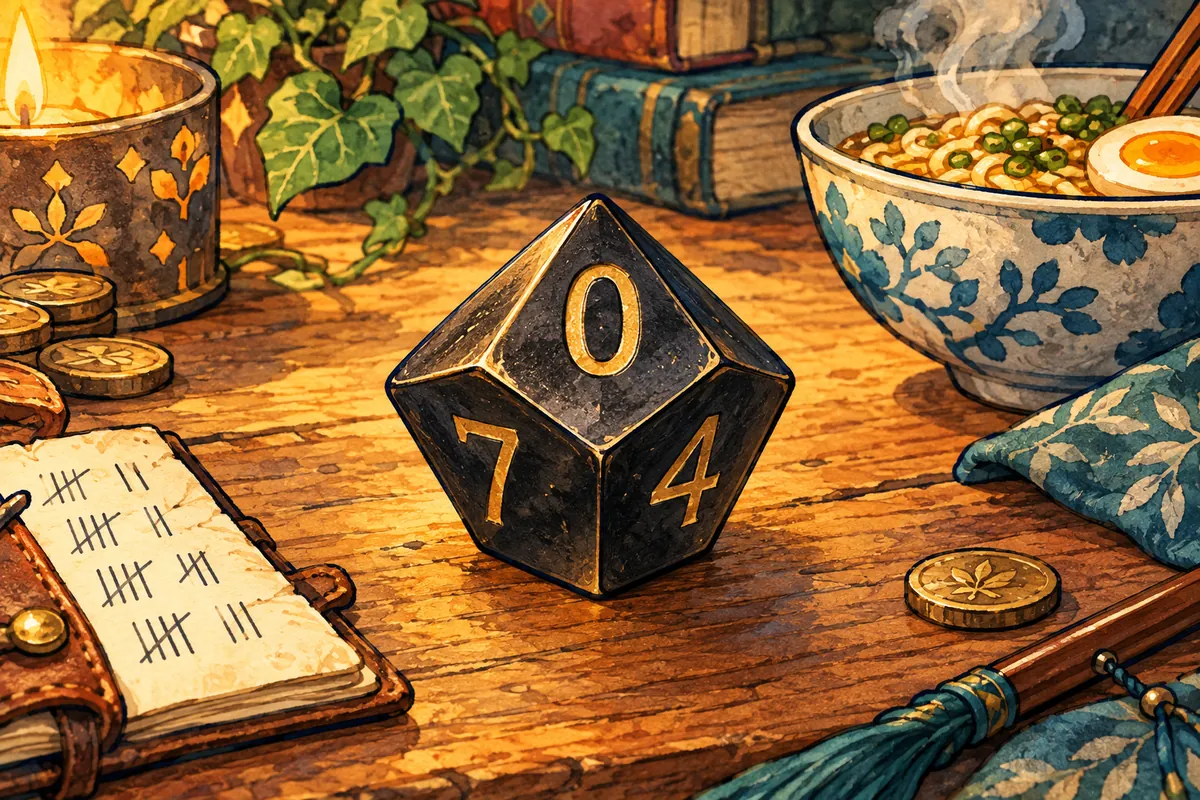
Damage, pools, and ten-entry lists
Use it for d10 damage, a ten-row event table, or a game that asks for individual D10 results. Some pool systems count successes instead of adding every die; always read the relevant rule before interpreting the tray.
Equipment from the seventh row
For a ten-entry equipment table, a roll of 7 selects entry seven. Each entry has a 10% chance. For a percentile skill test on a 1–100 scale, open the D100 roller rather than treating a single D10 result as a percentage.
A printed zero often represents ten
A physical D10 often prints 0 where this roller displays 10. For an ordinary 1–10 roll, 0 is commonly read as 10. Percentile dice have a separate tens-and-ones convention, so do not carry that interpretation across automatically.
Two D10s do not make a percentile
Adding two D10s produces 2–20 with 11 the most common total. It does not reproduce a uniform D20 result, and it does not produce a percentile roll.
One tenth belongs to every face
The mean is 5.5. A face of 10 has the same intended weight as 1, and an ordinary 1–10 roll has no extra zero-valued outcome hiding in the range.