
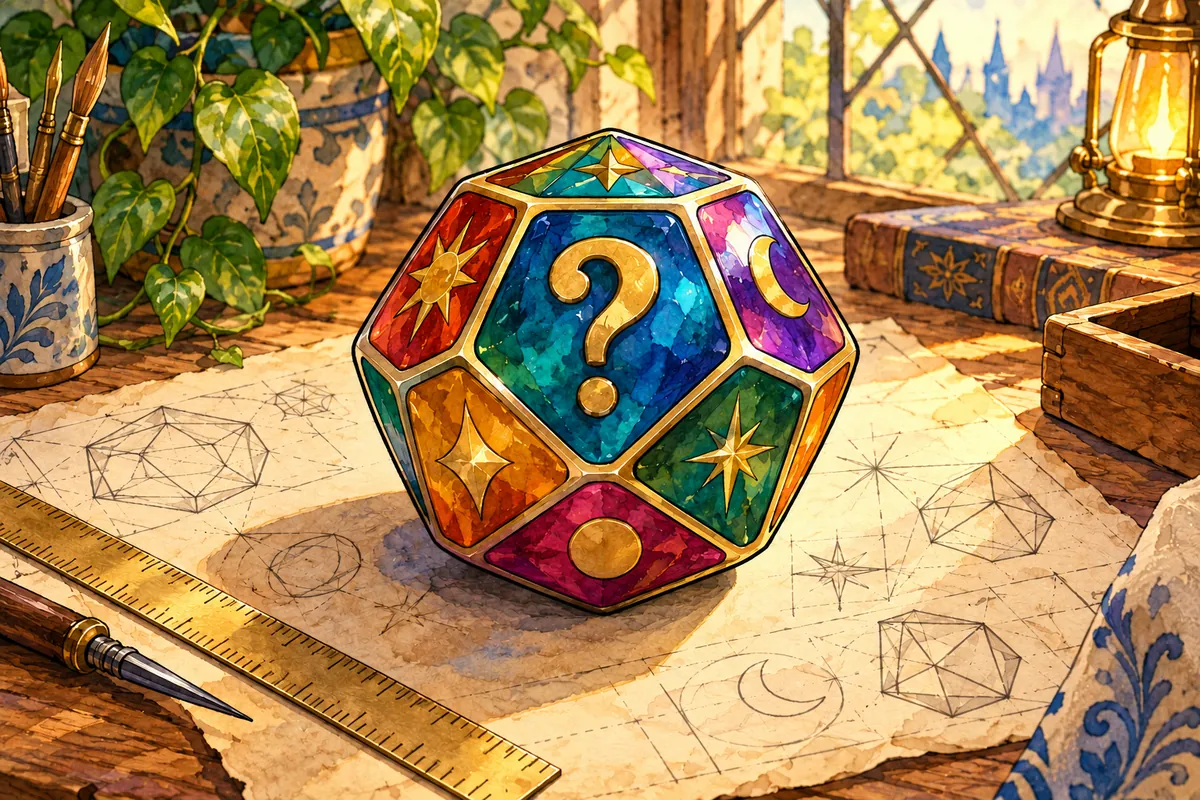
🧩 The Weirdest Dice That Actually Make Sense
D3, D5, D7, D24, D30, D100 and other shapes that make a cube look conservative.
A die does not have to be a cube. It only needs a set of readable outcomes and a rolling method that gives those outcomes the intended probabilities. That leaves a surprising amount of room for strange hardware.
D3: three outcomes without a triangle landing flat
A three-result die can be made in several ways: a long prism, a specially shaped body, or repeated labels on a more familiar solid. The important question is not "does it have exactly three physical faces?" but "does it produce three outcomes with the intended chances?"
D5 and D7: awkward on purpose
Five and seven are inconvenient if you want a regular convex polyhedron with one identical face per result. Manufacturers solve that with unusual prism-like or barrel-like designs, or by using more physical faces with repeated values.
D24 and D30: surprisingly elegant
Once you move into larger polyhedral families, 24-sided and 30-sided dice can look much more natural. They are uncommon in mainstream games, but excellent for tables where one face should map directly to one entry.
D100: sphere pretending to be paperwork
Physical D100 designs exist, but many players use two D10s instead: one for tens and one for ones. That is easier to read and usually stops rolling before everyone else has gone home.