
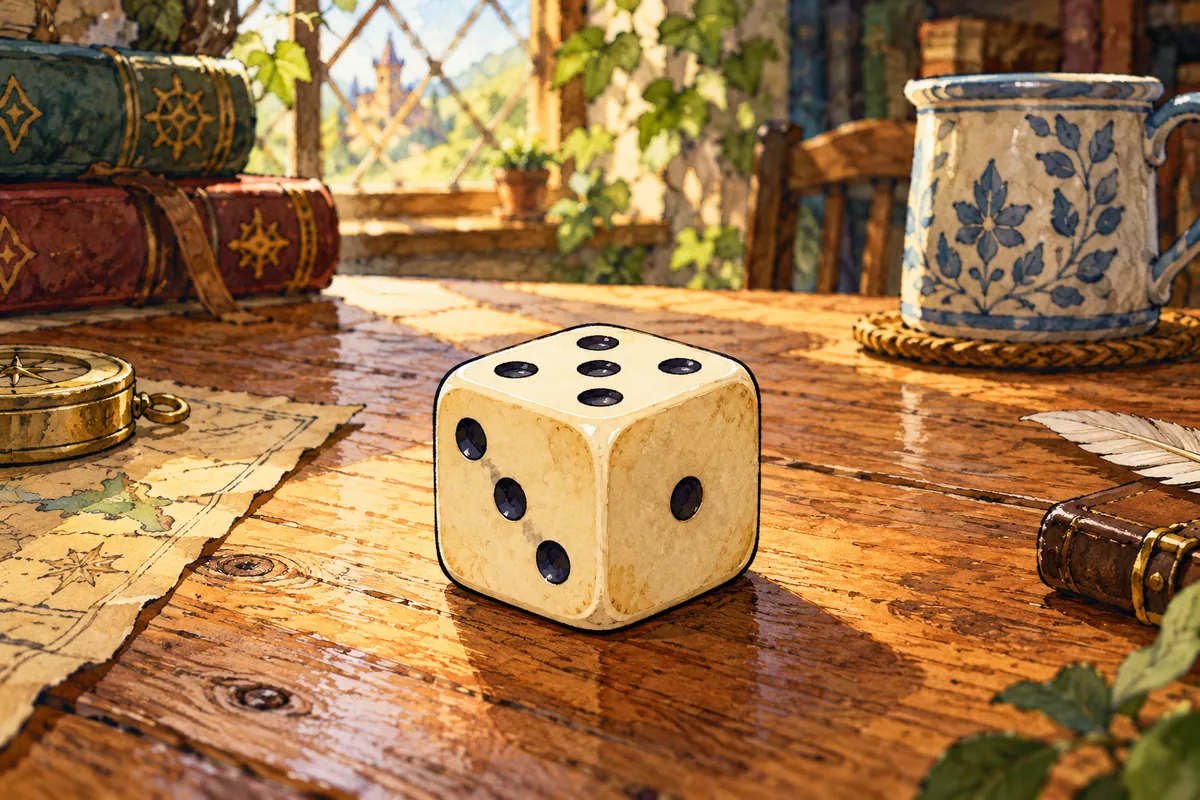
🏺 A Short History of Dice
From knucklebones and ancient cubes to the plastic polyhedral set on a modern game table.
Dice are older than most games we can still name. Their exact birthplace is hard to pin down because people in different places discovered the same useful idea: mark a small object, throw it, and let chance choose an outcome.
Before the cube
Some of the earliest randomizers were not manufactured dice at all. People tossed animal knucklebones, shells, sticks and other objects whose different resting positions could be read as different results. Knucklebones were especially convenient because they naturally land in a limited number of recognizable ways.
When six faces became a very good idea
Cube-shaped dice appear in the archaeological record in several ancient societies. A cube is unusually practical: it has six equal square faces, is easy to number, stacks well, and produces a compact set of outcomes. Once the markings are standardized, everyone at the table can read the result immediately.
The familiar pip pattern is only one visual language for those six outcomes. Across time, dice have used pips, numerals, symbols and words. The important part is not the dots. It is the agreement that each stable face means something.
Dice become game hardware
For centuries, dice were used in race games, gambling games and social games. They were cheap enough to carry and simple enough to understand without a board. The same object could decide movement, scoring or whether a risky action succeeded.
Modern tabletop gaming expanded the family. D4, D8, D10, D12 and D20 dice made it convenient to use probabilities other than one-in-six. Role-playing games helped turn the mixed polyhedral set into a recognizable object of its own.
And then the die became software
A virtual die has no physical face to land on. Software generates a random value and the interface turns that number into a familiar rolling ritual. The object changed, but the social function barely did: a group wants an outcome that nobody at the table directly chose.